Blog

Illenium at Sphere [Spoilers!!!]

North Coast Music Festival, Chicago, August 31, 2024

A couple of years ago, my son needed something to look forward to. He knew that his favorite music artist, Illenium, was playing at Chicago’s North Coast festival that summer. He also knew that money was tight, and with tickets, hotel, and gas, it’d cost a few hundred dollars, even if we only went to one day. I said we’d make it work; just let me know when he found out on which day of the festival Illenium was performing.

I pestered him for a playlist of songs he thought most likely to be played by the artists he was most excited to see at the festival. My favorites ended up being songs from Illenium, Dabin, Said the Sky, Slander, and Seven Lions.

As it got closer, I started stressing about what to wear. I wanted to dress in a way that showed that I knew I was at an EDM concert and showed respect to the artists, but also showed that I was cognizant of my being a 50-year-old mom. My son said anything would be accepted; most guys would be in a t-shirt and shorts. He also warned me that some of the girls would likely not be very covered. I settled on a slim black t-shirt, pants, boots, and blue diamond necklace and ring.

Concert day, we drove six hours, checked into our hotel, freshened up, and drove to North Coast. We did the Ferris wheel, wandered around and peeked into tents, and bought some Illenium jerseys. We meandered into the largest venue on the grounds (the stadium), found some seats above the crowd with a great view of the stage, and settled in. AllyCvt was playing; everyone was going crazy. As the sun began to set, Armnhmr took the stage with awesome visuals and music. Dabin and Said the Sky put on a combined show–Dab the Sky–which was full of really cool images, one awesome song moving into the next, everyone jumping and singing, songs I knew well and other songs that became my new favorites. Then Seven Lions did a set of what to me sounded like death metal–nothing like his songs on the playlist my son sent me–but the crowd loved it (and the Viking-esque images that filled the gigantic screens). Finally, Illenium came on. What a performance! The music was amazing, but with fireworks, shooting flames, lasers, and huge screens full of artistic images.

Illenium at North Coast 2024

Near midnight, a security guard came by and said the entrance to the balcony had been blocked off a couple of hours ago and that no one was supposed to be up there. We went down into the thick crowd and found a place to stand against the upper wall of the lower seating. We settled just in time for the opening chords of “Good Things Fall Apart.” It hit me hard. I felt embarrassed at the tears running down my cheeks, but I told myself that no one was taking any notice of it, and they wouldn’t be too critical if they did notice, so I kept singing out with everyone else.

Since then, Illenium has played at a bunch of “over 21” venues, which my son is too young to enter. Illenium played at Red Rocks, but at the one time we couldn’t get there.

Making Plans for Sphere 2026

A few months ago, my son told me Illenium was doing a residency at Sphere. I asked if there was an opening act, like Dabin or Said the Sky, and he said nothing like that had been announced. He got on the list to be notified as soon as tickets went on sale. When they did, we got the best tickets we could afford, which were on opening night. I immediately opened a new credit card that had a sign-up bonus for airfare and travel, and I booked the hotel, plane, and rental car.

A couple of days later, my son said, “Illenium just announced that there are opening acts.”

I said, “Who did we get?”

“Alok.”

I only knew him by his song as a featured artist on the new Illenium album, “Odyssey.”

He continued, “Guess who’s opening the next night?”

“Oh, no. Don’t tell me it’s Dabin or Said the Sky.”

He said, “No.” Then he added, “It’s Dab the Sky.”

“Augh! If only we’d known!!!” Then, half-jokingly, I said, “How much are tickets for the next night?”

I ended up getting us one more set of tickets and one extra day at the hotel.

I stressed again about what to wear. My son again assured me that anything was fine, but Las Vegas can skew rather upscale, and I didn’t really have anything. I shopped local, but there was nothing modest, flattering, slightly upscale, EDM-scene-ish, and affordable. I tried altering the jersey I bought at North Coast, but ended up ripping out the darts and seams I’d carefully put in after deciding it looked much better as a boxy jacket than as a fitted shirt. Then I spent a few days searching for an outfit on eBay. I found three possibilities and ordered them all (less than $100 for all of them). One of them was just about perfect–a black substantial stretch-knit cap-sleeve knee-length fitted Ralph Lauren dress. I also ordered a big sparkly pendant. A couple of days before the trip, I realized I’d forgotten about shoes, and I certainly didn’t want to wear high heels. I found some chunky black platform slides on clearance and bought those.

As I drove us from Alpine, Utah, to Las Vegas, my son made a new playlist on my phone with all my Illenium, Dabin, and Said the Sky. We talked about our favorite songs, he talked about some of the technical work going into the songs, and he didn’t object when I sang along to some. Passing through the beautiful Virgin River Gorge, I started to get excited. At Las Vegas, We checked into our hotel, then spent the next couple of hours looking at the shops on the Strip and eventually hitting Gordon Ramsey’s Fish and Chips for dinner (incidentally, not quite authentic because the fish and sauces actually had flavor, unlike any fish and chips, or any meal, really, that I ate the entire time I was in England) (still, I would’ve liked the sauces and batter more flavorful; my number one is still Boshamp’s Grouper Sandwich with house tartar sauce in Destin, Florida).

Opening night at Sphere: March 5, 2026

After dinner, we headed back to the hotel and got ready for the concert. I tried to straighten my hair (it is the desert, after all, so it should have worked). Google Maps told us to walk around the block, which ended up being a very windy trip (so much for my “straightened” hair!) to Sphere. We took some selfies, and then we went inside to wait in the crowd mingling in front of the inner doors. First I noticed that every girl had perfect hair, and many had incredible up-dos and/or colors that matched the Odyssey album. Then I noticed how much cool customization different girls had done to their Illenium gear–alterations that actually worked to give their jerseys a more feminine fit; sparkles in the fabric; gems outlining the trim, number, and phoenix; tricked-out half-shirts with chains; etc. I told my son that I was just going to cover my head with my North Coast jersey for the next 45 minutes. When I started to carry out my threat, he snapped a picture and said I looked like a nun.

I said I was the oldest person in the crowd by far. He said, “No, that guy’s older.” I looked where he pointed, and said, “No, I think I’m older than him.” He said, “No, THAT guy,” and pointed over everyone’s heads. I said, “Okay, so I’m ALMOST the oldest one here.”

However, I soon realized that pretty much everyone was kind and interested in each other–it was less inspection and more curiosity–and all of us were unified in being filled with anticipation.

The doors opened, everyone cheered, and we flowed in. The interior room was decked out in Odyssey colors, there were huge golden phoenix inflated “statues” for selfies, there was a huge panel of little fans making hologram-ish displays of rotating angels.
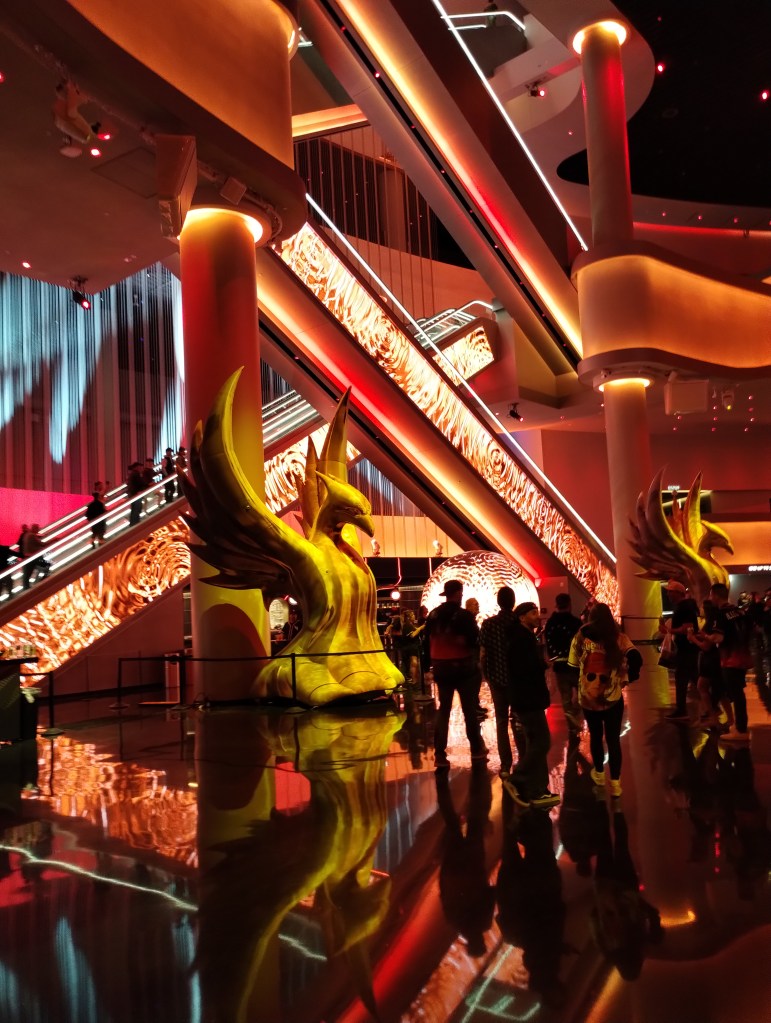
They checked our tickets again at the doors to our section, then we found our seats (in the 200 level). The circular interior was lit up with an image appearing to be a humongous quilt made of squares cut from Illenium jerseys from tons of past shows, detailed down to the quilt stitching on the edges of every square, the quilt appearing to gently undulate, light and shadow playing across it as if it were a gently blowing curtain.

Illenium jerseys “quilt”

We talked to our neighbors–one of them had been to Paris not too long ago–we agreed that the food in Italy was the best we’d had in Europe. We talked about where we’d seen Illenium before and what each concert was like.

When Alok came on, lots of people loved his show. However, the bass (or “wub-wubs”) was so strong it made my heart and upper ribs feel like something was going wrong with them. I hadn’t said anything, but my son looked at my face and said, “No, Mom, it’s not going to give you a heart attack.” I stayed as long as I could stand it, and then I opted to go hang out in the halls for the duration. I visited the girl’s room, and I was surprised to see that the line was SHORTER than the men’s room line and was actually moving quickly–I’ve been to so many concerts (and other events) where the guys have plenty of bathrooms and the girls are missing half the event because there aren’t a proper number of bathrooms for them. A couple of girls in line with me were joking, “The guys finally know how it feels!”

When Alok ended, I went back in and saw a timer counting down on the black ceiling, a swirl of light around it. The crowd counted down the last seconds together, and then everything went dark.

Illenium began the performance with the actual start of the “Odyssey” album, surrounding us with intriguing images. Then there were a few chords that I expected to transition into one of my favorite songs on the album–”Into the Dark.” But I was teased, and he made a different song materialize, with images of light and dark, breaking apart, coming together–swirling galaxies (one light, one dark) with black holes in the middle, turning into planets, one light, one dark–with releases of energy.

The motif of light and dark in conflict reappeared throughout the immersive experience, but it wasn’t always overtly constant. For example, at one point, suddenly the entire Sphere surface turned “the blue screen of death” we’ve all grown up with, and a computer text error message appeared. I was 99% certain it was part of the show, but still a little part of me wondered if it was possible, on this opening night, for something to have gone wrong. I could hear similar non-verbal expressions around me. Then there was an error message in a text box, and then more, and more, with crazier and crazier error messages that got us all laughing, and then the text looked like the Phyrexian text on some of my Magic the Gathering cards, and then everything melted down and was replaced with a computer text “Bring Me to the Horizon” that raised a huge cheer, and then the title of the next song, followed with something that I found creepy but which as I watched I thought: “My daughter would LOVE this. I’ll have to record it tomorrow night.”

There was something for everyone, and something to appeal to different parts of each of us: fight scenes, sweet scenes, mysterious images, scary images, songs that got us jumping up and down with our arms in the air, songs that made us slowly sway back and forth, music to let flow over us as we silently listened, and music to bring out the bold singer in all of us. At just the right moment, Illenium gave us “Into the Dark.” What a payoff!

One of my favorite parts was a surprising mix of “Paris,” a beautiful instrumental track on “Odyssey,” with “Gorgeous,” a song on an earlier album that I like well-enough. I never would have thought of combining them. Together, they were much more amazing than either is, alone; and the images of the light angel with the white swirls and spirals of feathers around her as she sent rings of white energy above her was as gorgeous as the music claimed it to be.

“Paris”/”Gorgeous” Light Angel

Too early, Illenium was telling us it was time to part. He invited us to thank his guest performers (strings, piano, soloist), which we did. As we clapped and cheered him for the experience he’d just given us, I told myself I couldn’t really be seeing tears in his eyes, but then he said, “I’m [strong expletive] going to cry. I love you all so [strong expletive] much!”

We stayed and read the end credits while listening to the sweet (but dark) waltz of “Monster,” and we laughed at the last image of all–Illenium’s wife’s doggie in the form of a nebula.

We followed the crowd back through the adjoining hotel (a much shorter trip, as it turned out, than Google had directed us to take there). I listened to bits of conversation around us. Many people were talking about what the angels represented, and their views were highly divergent. We ended up joining the conversation of a couple of guys walking to our same hotel. One said the two angels were really the same person. The other disagreed, saying they were more like sisters growing up with an overbearing father. I nodded slightly, as in an instant thoughts I’d had during the concert flashed through my mind (I’d thought that one of my brothers would see God in the giant, controlling man; but my experience is that the more decent I want to be and try to be, the more I feel that God sees me as needing less detailed guidance and that He sort of “sets me free” to do whatever good things I want; and if He’s arranged things in a certain way so that I have tough things happen, I’d rather be like Paul’s term “a fool for Christ” or like Job’s “even if He slay me, I’ll trust in Him” than someone who lies, cheats, steals, takes advantage of others, etc.), and in the next moment I pointed out different symbols, story events, and images that supported the first guy’s interpretation. We kept talking until they got out of the elevator on their floor.

The conversation made me think about my English major classes. Not just the interpretation of symbols and motifs, but the various approaches to experiencing and interpreting literature (and all art). In particular, the audience response analysis insists that the author has no interpretive power over a text that’s been released to the world; each person experiences the text uniquely based on their own life experiences, and if a person finds within a text meaning the author never intended, that meaning is just as valid as the author’s own interpretation. (Sort of like how I read “Birches” as a male narrator who delights in remembering his sexual conquests in boyhood, and I hate him for it; when Frost’s intent was likely entirely innocent.)

The conversation also made me think that the concert was almost an epic version of those Rorschach tests, where sometimes the image is obvious, but more often it’s a key to unlock what’s going on in the person’s subconscious mind (or what’s coloring, or even dominating, all their thought processes).

We slept late the next morning. Eventually, we went out looking for breakfast. After winding around for a couple of miles through the Forum at Caesar’s Palace and the Venetian shops, we ordered crepes, a turkey BLT, a pizza, and lemonades from a French place. After that, we saw the Bellagio fountains show. Then we scanned the QR code to enter the Illenium “pop-up” shop, entered through a somewhat mysterious dark passageway, and found ourselves in a line to take a selfie with a phoenix on its nest. Although I hadn’t really formed an intent to get anything, I ended up buying my son two jerseys. I also realized the Illenium pashmina was the perfect accessory for that night’s performance, so I got one for me. We walked back to the hotel (with the uneaten pizza), and I read a book on my phone while my son took a nap.

Friday night performance: March 6, 2026

When it was time to get ready, I had marginally more success in straightening my hair. My son wore his new Odyssey jersey. When we left our room and started walking towards the elevators, three guys wearing Illenium gear were coming down the hall from the opposite direction. They started to say “Hey!” to my son, and as I unfurled my new pashmina, they said, “Is that an Illenium pash? No way!” As we took the elevator, we started talking about the show (they’d also seen it the prior night, so no spoilers). They were friendly, but there was something weird in the air. I was guessing what it was, so when they asked if we were going to a certain other performer’s show after, I took the opportunity to say, “No; I have to get my son back to college.” Their faces cleared, and then with much more friendliness they said to my son, “You’re taking your mom to Illenium?!? Sweet!”

Inside Sphere, we shared a plate of honey barbeque chicken and fries, which were surprisingly good. I got a Liquid Death sparkling lime water and my son got a regular bottled water, and we found our seats (front row 400 level). The jersey quilt “draped” over Sphere’s interior now included a Said the Sky jersey that I hadn’t remembered being there the night before. There was also a huge glowing nylon phoenix, maybe six feet long and wide, slowly circling above the floor. We didn’t see any wires, so we guessed it was some sort of drone.

Dab the Sky put on a great show; but I knew far fewer songs than I expected to because (drum roll) they played FOUR brand-new, never-before-released songs! I noticed Said the Sky kept sneaking glances at the grand, ever-changing light display behind him; it made me smile because I know well the irony that stage performers never get to see their own show live.

Dab the Sky performing at Sphere
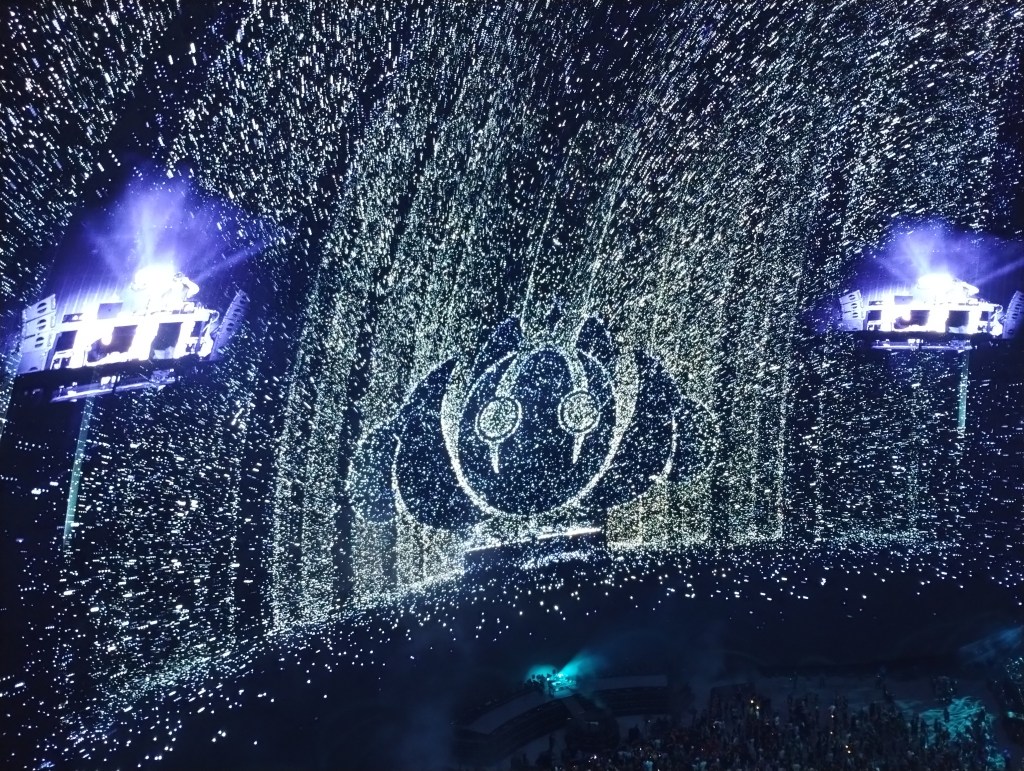
I couldn’t believe it when they started to close their show–how had an hour passed already? They thanked Illenium for his graciousness that once he’d achieved the success of booking Sphere, he’d invited as many of his friends as he could to share the stage with him and give them, too, that awesome experience of performing in such a unique venue.

Then the countdown clock appeared over our heads. We were even louder than the night before at “4…3…2…1!!!” In many ways, I enjoyed the show even more the second night–I was watching for things I’d missed (there was just so much going on, visually, that it was impossible to take it all in the first time), I was anticipating my favorite parts, and I had no anxiety about how far the visuals would go (Sphere is capable of some really trippy, unsettling visual effects, like the ceiling coming down to crush you).

The first time Illenium invited us to sing, I immediately responded with my best voice. The guy next to me kind of did a double-take, and then his previously barely-audible voice was freed to sing out with everyone else.

Comparing the 200 to 400 level: Vaping is strictly prohibited, but somehow there were vape fumes both nights, and they were much stronger at the 400 than the 200 level. The bass seemed much stronger/louder on the 200 level than the 400 level, but the seats on the 400 level vibrated much more than the 200 level. At the 200 level, you’re craning your neck a lot to look at everything above you; at the 400 level you can see everything in greater comfort but it’s slightly less immersive.

After thoroughly enjoying yet another amazing performance (one that also seemed to end too soon!), we made our way back to our hotel. My son showed me an Instagram “story” post by EDM artist William Black–apparently, he’d brought his dad to Illenium that night even though he was performing in New York City twenty hours later. My son said, “We’re not the only ones doing the ‘Bring a parent to Illenium’ thing!” My son later sent me this link with the comment: “See not the oldest” and two thumbs up:

Not the oldest

We got a few hours of sleep, then drove to catch our shuttle and flight out of Salt Lake City. Walking through the airport to my gate, I was having trouble stopping myself from singing bits of song from the performance as I was revisiting the experience.

The next day, as I was sitting at the church piano using music to help twenty little kids (who were way too wired from the effects of Daylight Savings Time) to channel their energy in a positive way, I had a bizarre thought that what I was doing right then had the tiniest, mini-est, fractional speck of a kernel of similarity to what Illenium had done with 20,000 adults on that grandest scale at Sphere. Maybe that thought put a little extra soul into my rendition of “This Little Light of Mine.”
Soaring Phoenix

Being an Extra

My whole life, I’ve enjoyed performing in theater and music; in more recent years, I’ve taken assistant director roles for middle school and high school plays and musicals. In the early 2010s, my church (currently about 17 million members) began a project to make short videos depicting events in the scriptures. (One of the main goals for this project was to make the scriptures more accessible to people the world over.) Every year for more than a decade, I filled out the application to be an extra in the coming year’s shooting season. Some years, when they had minor parts with lines available, I memorized, recorded, and uploaded my audition. But I never got a callback.

Then, in 2019, I got a booking! I left Missouri and flew out to the Utah desert. For one day I was an affluent Zoramite worshiping idols. It was a long, hot day (pre-dawn to dusk, about 106 degrees) and I loved every moment (my post in “To Beard or Not to Beard” talks a little about that day).

I applied again the next year, but the season was cancelled due to COVID. I re-applied the year after that, and months later I got an email. I opened it, hoping it was a booking, and wishing I might get two or maybe even three days.

I was offered 23 shoot days over five-and-a-half weeks.

I read it again. Then I wondered if it was meant for someone else and I got it by mistake. (I don’t know that I’ve ever completely gotten over that feeling.) I’d never left my kids alone for more than four days, and that was only while giving birth to one of them. But they assured me that they’d be okay (they were all in their mid-to-late teens, they’d been to overnight camps and conferences, etc.; it’s just that this was for a much longer time and distance away).

Soon after this, my oldest son was offered three shoot days, then six more, so I had his company for part of the time.

My brother, who lives about an hour from the set in Utah, let me stay with his family and borrow his car for free. So, he and his family are heroes who made this possible for me.

FIRST DAY

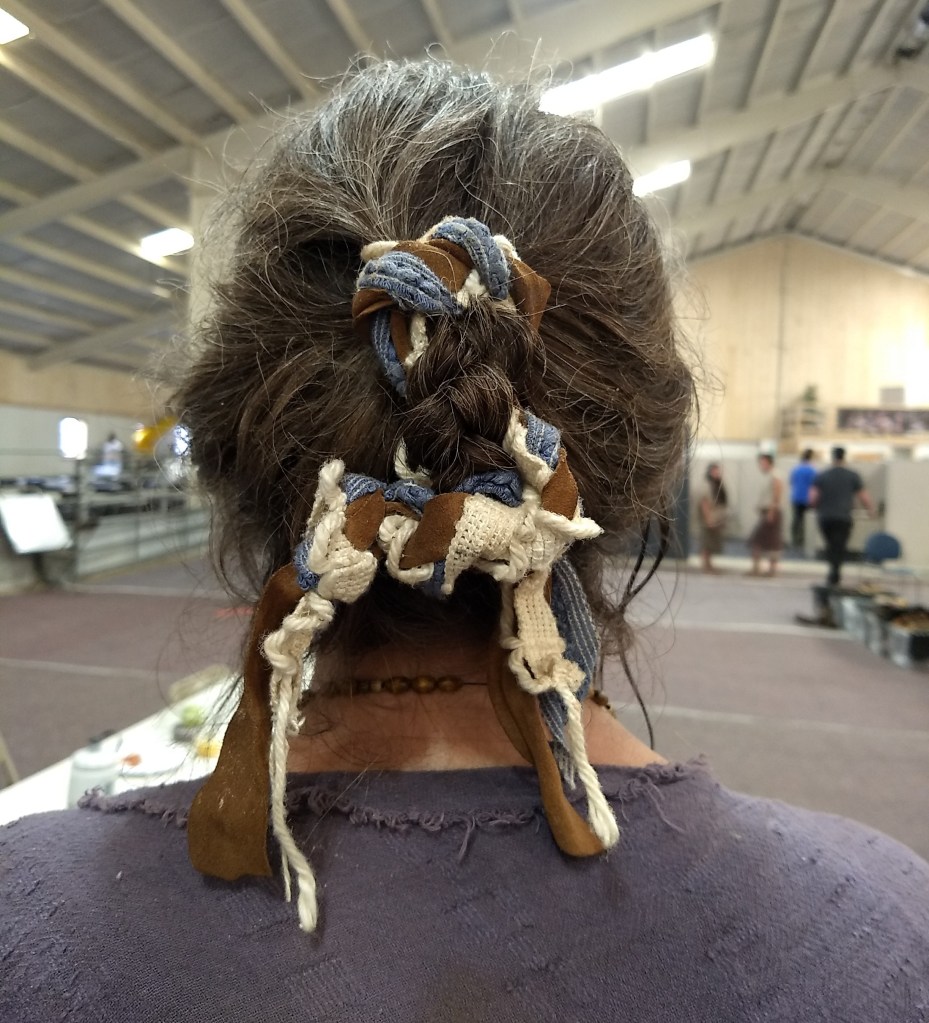
I drove in the dark to the remote desert canyon. Attendants told me where to park. I walked to the shivering cold barn (desert nights are cold; desert days are hot) and checked in to begin the process of getting ready for the shoot: lots of stations, lots of lines for each station. As part of the forty “core” extras, I was assigned a specific costume (freshly laundered) that I would wear every day for the next five-plus weeks. From the buckets of sandals, I choose a pair that I hoped would not give me blisters. I ducked into one of the several curtained partitions to change. Then I got inspected to make sure I had no makeup, nail polish, or jewelry. Then to “skin tone” to cover my tan lines and get sunscreen. Then outside to “dirt,” where I got two layers of spray dirt on my skin and some special dirt brushed all over my costume. Then back inside to get my accessories. Then to hair, where I was given the coif which would be replicated exactly the same way for each day of filming (they chose a quasi up-do which was parted down the middle to show off my gray to maximum effect). They used my phone to take pictures so I could show the “hair” people the next morning and every morning thereafter. (Phones were banished on-set, and reception was terrible in that remote area, but they still served their purpose.)

The sun came up, and vans took us up a rocky dirt road. A strong guy (who turned out to be a university art professor that had taught my daughter in a week-long design program) mentioned it’d be cool to carry one of the young goats on his shoulder. Somehow, it came to pass. (I may have mentioned something about it to one of the assistants.) He carried the constantly bleating animal for the next hour while we walked back and forth through the mountain field.

Then the vans took us higher. When the terrain became too steep for the vehicles, we unloaded and walked way up the trail. Others who had been driven up earlier had already claimed the sparse shade from the scrub oaks, so I continued up the trail, rounding a bend, until I found a tiny bit of shade further up the mountainside. Then we waited for them to finish setting up the shot. I crouched into the bushy trees and put my bag and gourd over my feet to shield my toes from the burning sun.

After some minutes of waiting up there, alone, I heard a large rustle from the center of a stand of scrub oaks not too far away. I stared at it, and I determined there was no wind and the rustle was too big to be one of the prairie dogs that had just run from that area. I knew of recent cougar sightings (and even attacks) in remote mountain areas in that area in Utah, so I was concerned. A few minutes later, another large rustle came from the same patch of scrubby trees, but closer. I decided I didn’t want to be the idiot woman who got eaten by a cougar on her first day of shooting, so I determined to go back down into the baking noon sunshine (Crew members later told me that the temperature on our ridge was 109 degrees). But just then, Abraham came into view. (Abraham was easily the largest and strongest man on set. In later weeks, other extras told me about going to the gym with him and seeing him load five 100-pound plates on a machine and lifting them.) He asked if I minded if he sat with me. I said he was welcome. He took a scrub oak a few feet higher than mine. As we talked about his amazing life experiences, I felt perfectly safe–no cougar would ever be so stupid as to attack with him nearby. And, there was no more rustling. (A few days later I told him he saved my life that day.)

They set up the ridge shot, and we walked along it several times with our sure-footed goats and sheep while we learned not to look at the drone zipping by just over our heads.

We walked back down to the vans and were driven to the barn for a late lunch. Then we went far away to a completely different field up in the mountains. While they set up the shot, they brought camp chairs for us and we set them up in the shade. They continued to ply us with water and electrolytes. Then they brought out a basket of chocolate balls, and everything became right with the world. When the shot was ready, they ordered us in groups and set us up at the top of the long meadow. Then they said, “You need to PRETEND you’re hot and tired,” which drew a laugh out of us. They told us to imagine what our own character had just been through, to create a story for this individual we were trying to inhabit. I created that story, and then hiked wearily up and down the meadow for the last takes of the day.

Back at the barn, with the sun about to set, I changed out of my filthy outfit and accessories and hung them up. As I was checking out, I suggested that, if we were supposed to be this dirty tomorrow, maybe we should just sleep in the dirt on the barn floor. Instead of laughing at my joke, they quickly reminded all of us of the importance of personal hygiene.

When I got home, it was dark, which was a blessing because my eyes had been stinging from being out in the sun all day. When I met my nieces and nephew, they looked aghast at my filthiness. I agreed with them that I “really, really, really” needed to get cleaned up. Then I went downstairs to the bathroom and felt thankful for the blessing of lots of soap and clean, hot, running water.

THE LIGHT

In filming the scenes with Christ, the actor’s flowing robes were kept brilliantly white–before each shot, they were inspected to make sure no speck of dirt had dared adhere to them. During the first shot, the sun was almost directly behind him. A gigantic light-box suspended from a crane illuminated him. And, lest there be a shadow of a chance of a shadow, another light source took care of that. I could barely look at him, he was glowing so brightly.

We ran the scene many times, from many angles. It was physically exhausting in the heat and sun, of course. But it was also emotionally exhausting, in a wonderful way.

At one point in the late afternoon, a large bank of clouds rolled in, graciously sheltering us from the sun’s onslaught. After a few minutes the director said, “I know some of you have been praying for better weather for the cast. But we need better weather for the shot. So, please pray for the sun to come out again.” I joined with the others who followed his admonition, and in a few minutes there was a small break in the clouds, which allowed them to get in the last three shots they needed before we broke for the evening.

TECHNICALITIES

Before every shot, the head cameraman would look through his camera and announce his light levels. The directors would make adjustments for him (moving screens, turning light boxes up or down, etc.). He’d check the shot and call out if he saw something out of place or if people needed to be rearranged, then the directors would make the needed changes happen, and then we’d finish the set-up and get straight to filming. He was extremely efficient and professional.

One of the days that had hundreds of extras, after we’d all been processed, we were placed seated on the ground in front of the temple. The assistants had discreetly placed pieces of carpet on the stairs to keep the actors’ feet from being singed on the steps that had already absorbed too much of the sun’s heat. We waited while mini railroad tracks were set for the cameras to run along during the shoot, and for the last screens and light boxes to be placed. Then we were arranged so the principle actors in the scene could easily walk through us without a huge amount of people shifting to make way but also without leaving obvious paths in the crowd. During this wait, I told a certain kid seated next to me to stop throwing mulch and dirt at the other little kids (and I reflected once again on the unfairness of the practicality that you always learn the names of the naughty kids first and the helpful kids second).

While filming a different city scene, one with lots of walking and lots of sheep and goats, between takes I heard a young lady shout: “You think that’s bad? I had a goat pellet stuck in my sandal! And they’re LACE-UP!!!”

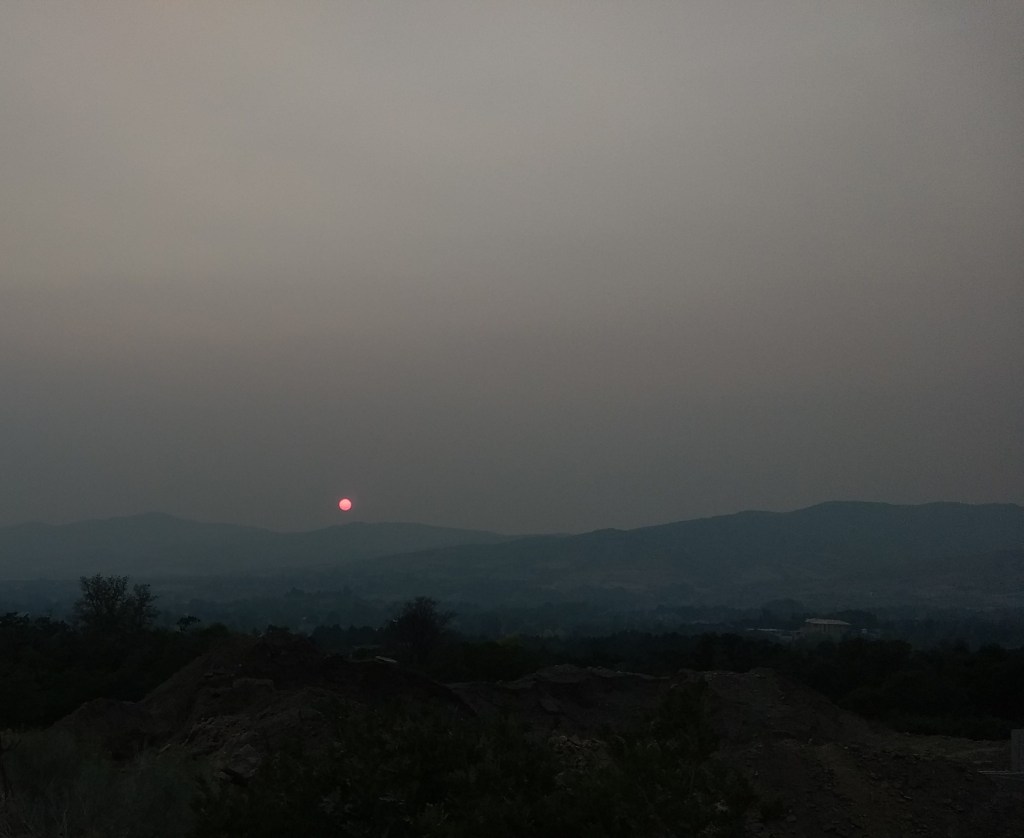
That summer, the California wildfires were so bad that on certain days you couldn’t even see the mountain peaks right next to us. On one of these very smoky, very long days (pre-dawn to almost dusk), the fire-lady still kept coming through to light the powdered walnut shells in the firepots to produce the smoke needed to filter the light and provide the right atmosphere to the film. Several people around me were complaining about the smell and about their eyes stinging. Some had even surreptitiously closed the cover of whichever firepot was nearest them. When the cameraman ordered, “More smoke!” there was an audible groan as the fire-lady immediately appeared with her blow-torch. There was some hostile murmuring as she approached my area. I decided something needed to be done to break the tension, so I yelled out, “We know you’re just doing your job, but: Fie upon you, Fire-Lady! Fie!” which made everyone laugh, including her.

During the filming of the passing of the sacrament, the director told us all to be thoughtful and reverent, and to take a piece of bread and eat it every time it was offered. One of the disciples came to our section of the multitude, offering his dish of bread to each of us in turn. When he offered it to me, as I reached for it, he withdrew it, so I retracted my hand, keeping a reverent, pondering expression on my face. He did this twice more, and I remained reverent as he teased me. Then he offered it in earnest, and I took a piece and ate it thoughtfully. When the scene was finished, he sought me out in the crowd, held up his hand for a high-five, and when I gave it to him, he said loudly, “You are a true actor. You didn’t break at all!” which made me glow inside.

While filming certain of Christ’s miracles, there was a white cloth above us, softening the brilliant sun. The director came to our group and said there should be a sacred feeling during this scene, a sacredness comparable to the temple. The camera was behind me, and I volunteered to have my shoulder frame the scene. The cameraman taught me exactly how to shift my weight so that I would always be in the right place as the actors entered the frame and the camera adjusted. I knew my face wouldn’t be in the shot. But I wanted to portray my character as best as I could to help my fellow actors who would be seen. As the actor portraying Christ whispered the words of each blessing, I imagined I was seeing Christ healing my own daughter, and my tears flowed freely. Later, different cast members took me aside and said watching my reactions helped them portray their parts. I was grateful to have been placed in such a way that I could help make the scene maybe even a little more real than it might otherwise have been.

One morning, it had rained the night before, so the lines were soaked, making it impossible to safely film the scene of the angels descending. While crew worked on replacing the wet lines on the crane with dry lines, the director decided to go ahead with filming the ground scenes of Christ and the angels among the children. When the lines were ready, they cut filming that scene and immediately started working on filming the angels’ descent. (“Raise the Angels!” should be the name of a rock album, I think…)

The angels were cast with the idea that they could be the ancestors of those children they were ministering to, so they had a similar look to everyone on the set. Those angels also had been chosen after submitting dance recitals. That showed in their absolute grace as the lines quickly took them from above the height of the top of the temple down to the center of the group of children. The morning clouds had separated, leaving swaths of blue sky and puffy white clouds as a dramatic sky-scape backdrop. The sun was in perfect position, the giant light box made their white robes glow, and a giant low-speed fans mounted just out of the shot made their robes flow gently and beautifully.

In the afternoon we went back to filming the angels and Christ on the ground with the children. Because the sun was on the opposite side of the set, the director rotated our group about 110 degrees from our morning positions so we would have the same light and shadow on us. The director told us that what we said didn’t matter because this would be filmed at a high frame rate and played back in slow-motion with music over it. The director said what was important was that all those tired little children were smiling and talking in wonder and joy. Anthony, who portrays Jesus, started talking to the children about pizza. Then he asked about sillier and sillier kinds of pizza: “What about chocolate pizza?” He asked who liked pineapple on their pizza, and when some kids eagerly responded, he looked at them and said, “You need to repent,” which made them all laugh.

Towards the end of filming that shot, all the ground angels joined the descending angels, and a whole bunch of really little children joined the circle. The littlest kids were quickly scooped up by the fastest-acting angels, but all of the kids were in demand. By the end of shooting the scene, one of the littlest children had fallen asleep on her angel’s shoulder. She was so sweet cuddled there.

FAMILY

Towards the end of the season of filming, one Friday the director surprised us by saying the next afternoon there would be a “Family Day,” and he authorized each of us to bring people in our household to the set during a certain window of time. During my time, I gave my brother, his wife, their kids, and my parents a tour of the set, pointing out where all these things I’d been telling them about had happened.

I was told that there were about 6,000 extras hired during that season. There were roughly 300 on higher-volume days, with those hundreds of faces changing from day to day. What was really cool on “Family Day” was that when some of the assistants and directors saw me, people that I had never supposed knew who I was, they called me by name and complimented me in front of my family. I was impressed at how they “knew all their sheep,” so to speak. I can only guess that it was partially because, over the weeks of filming, I had become known among the extras as the extra to tell if there was a problem so that I could loudly tell the director about it. (My two years of college Spanish somehow was enough to allow me to be helpful to those extras who only spoke Spanish–especially to those who were new on set) (Some examples of things I brought to the directors’ attention: we’d been given conflicting instructions on whether to kneel or to stand; we were continuing a shot from a previous day and a brand-new extra had gotten in a spot that was going to create a continuity problem and the guy wouldn’t go to the right place; one of the children’s noses had suddenly started bleeding and they were about to start filming; an elderly lady had briefly fainted and needed a chair to sit on and some medical attention; some new assistants were mistakenly passing out the red electrolyte packets that would stain everyone’s lips and fingers bright red and needed to be stopped that second; etc.)

Even though I kept the “Family Day” tour short and tried to keep my parents and nieces and nephew in the shade as much as possible, they were starting to get overpowered by the heat after only a half-hour. I had to go get the car and drive them back because I wasn’t sure my parents would make it the half-mile walk from the set to the parking area. I guess I was more acclimated than I’d realized.

As I neared the end of the filming, and I joyfully anticipated being reunited with my family, I was extremely grateful to have been a part of this experience. I told people it was like Boot Camp and Youth Conference (a religious retreat for young people) combined. There were constant problems to solve, and it was exhausting, but it was just about the coolest thing ever to work with a huge group of people you’ve never met who are all united in a common goal to help bring people to Christ.

POSTSCRIPT

Months later, the first finished, edited video was released during a session of General Conference (a twice-yearly event where the millions of church members, and everyone else in the world, are invited to listen to speakers teach about Jesus Christ). Several of my family members, and some of my friends, texted me to tell me they’d seen me in the video. I told them they had amazing eyes, to catch those couple of seconds here and there where I was recognizable.

Shortly after the videos were released, when I was visiting local congregations to teach, there were a few people who took me aside and asked if I was in those videos, because they thought they’d seen me. It was cool to me that I got to be a way of connecting them to those videos.

Another time, my family group text lit up when my sister spotted me in a picture (a still shot taken from the videos) in the church’s scripture study manual for the coming week’s lesson.

Finally, I was playing piano in my local congregation for the little kids’ Sunday School as the music leader (who’d recently moved here from another state) taught the children a new song, “Easter Hosanna.” To help the class understand the song, she’d downloaded the church video that showed the scene described in the song. She had it up on the big t.v., cued in such a way that my face took up half the screen. When Junior Primary came in, she played the video, explained the song, and taught the song to them as I accompanied on the piano. I was wondering if I should say anything about being in the video, but then I thought it would likely distract from, not enhance, the chorister’s work. Then the younger children left for their individual classes, and Senior Primary came in. As soon as the older children saw the t.v., they started calling my name and exclaiming, “Is that you?” A bunch of the Primary teachers joined in while the chorister said, “I was WONDERING if that was you!” So, I got to say yes, that was me. Then I briefly told them that there was a really special feeling on the set those days, and I hoped they could feel that as they watched the video (I’d had time to think of that smooth segue during Junior Primary).

There is Nothing New Under the Sun (*Sigh*)

I was invited to do a reading for a sci-fi/fantasy group in Kansas City. After the reading, there was a Q&A. During the conversation, I mentioned Irish Wolfhounds, and I noticed a somewhat skeptical expression on the face of one of the participants. She also asked if I had read any Brandon Sanderson, and when I said I hadn’t and had been recently chastised for it, she said she was a beta reader for him, and agreed that Mistborn was a great entry point.

I read the Mistborn trilogy the next month. Wolfhounds figure prominently. I connected her skeptical reaction with that fact–that she may have thought I copied Mr. Sanderson’s idea. I had this feeling of shame: “How dare I ever use a wolfhound in a book! Everyone will think I copied Brandon Sanderson! How could I have been so stupid!”

After reading the Mistborn books, I looked up his BYU lectures on YouTube, and watched the ones on publishing. The self-publishing lecture mentioned a writer who has a student travel back in time. He said the books are extremely well-researched and she puts out a book every four years. I looked up this author on Wikipedia, and I sighed–my “Wow! That idea is so great, I can’t sleep–I have to write it!” idea was done decades before I even began writing.

In the MCU, I sometimes see little scenes and phrases that make me wonder if someone read my books and took a few bright snippets from them, or if I’m just that obvious (things like “ouch, ouch, ouch” when Spidey’s back is getting stitched up at the end of one of the movies–that’s at the end of “Stasis.” Or the line about making everything “a chaotic mess”–one of Evil Bob’s assessments of the heroine in “Stasis.” Or the Winter Soldier’s difficult relationship with his therapist, including his angst when she takes down a note-the heroine has a similar relationship with her counselor in “Stasis.” Etc.).

Years ago, I taught a Sunday School class of older teenagers. One Sunday just before class started, they were whispering with each other and laughing. They stopped when I went to the board and started setting things up for the lesson, but then one of them started asking me questions about myself. I gave them the basic answers, nothing to write home about, but after five or six questions they were all laughing after each of my responses. Then they asked me if I knew a person named Stephenie Meyer who’d been an English major at BYU about the same time I was there. I said I’d had a roommate by that name who’d left my bike outside for a party when I was gone for the weekend and it’d been stolen, but I didn’t know what she majored in. That got them rolling on the floors.

I didn’t know until my [then] husband’s birthday, when I asked him what he wanted and he said, “The ‘Twilight’ series,” that there was a famous author by that name. (She could not have been my roommate–she doesn’t look like her and ‘Meyer’ is her married name and obviously my roommate wasn’t married at the time.) Some time after he finished all the books, I read the series. There are details in there that do match a lot of things in my life, and the questions the kids had asked me a couple of months before were all about those things, so I could see why they laughed. But I saw an interview she gave where she said she’d made her main character, Bella, someone with characteristics that lots of women could identify with. Those similarities were like how a fortune-teller works–getting enough details right that you think, “How does she KNOW me so well?” and you ignore all the details that don’t match you.

People talk of a “spiritus mundi,” where every creative thought goes into a communal well from which anyone can draw. I remember hearing Sting say that he’d had a vivid dream and turned it into the song “The Lazarus Heart.” When he told a psychologist friend of his about it, the friend said it was the stereotypical dream of a certain group of, I can’t remember, fishermen tribes, or something. Sting’s response was something like, “I can’t even dream creatively!” The obscure fishermen had put their dreams in the communal well, and Sting’s subconsciousness had drawn it out, according to that theory. Every artist giving inspiration to every other artist to make new and more exciting things. A synergistic growth fueled by every individual’s creative energy and work. Nothing wasted, nothing lost.

Other people assume that anything new that resembles anything that came before is an act of copyright infringement. (Today’s laws are unworkable–I got a “copyright strike” warning on YouTube for putting up a video of me playing and singing Mozart’s ‘Alleluia,’ pirated copies of my books are up for sale on sites in China within hours after I publish them on Amazon, the “life of the author” standard means no one knows when old works by obscure authors are public domain, etc.) (My kids showed me this Tom Scott video, and I agree with the vast majority of it: YouTube’s Copyright System Isn’t Broken. The World’s Is.) These people can’t stand the idea of someone taking a tiny seed of an idea they had and turning it into an entirely different creative work. This attitude stifles creativity by requiring any creator to: 1) Know everything that exists; 2) Look over one’s own shoulder while creating to ensure that nothing that is being created bears any resemblance to anything that has ever existed.

However, there bad actors who grab other people’s work and are jerks with it–not just those who steal other’s creative works outright, either. For example, I think Miguel de Cervantes was perfectly justified in verbally sticking that loser author in a pillory and mocking that loser author’s lame copying of the Don Quixote character and mocking that loser author’s claim that his sucky book was a sequel to the original.

But there’s a continuum. Maybe Coldplay should’ve have had to pay some type of compensation to the guy whose guitar piece has the same chord progression as “Viva la Vida.” But to think that guy could’ve stopped Coldplay from making that song, a song that bears no resemblance to the guitar piece aside from the chord progression, sucks–it’s basically saying, “Let’s make the world a more boring place.” Should “Viva la Vida” not have been written, and should we, as a world population, been stuck with only the obscure guitar piece, just because the guy with the obscure guitar piece says so?

What if an MCU writer liked my, “ouch, ouch, ouch” scene and used it to make the end of a Spider-Man movie a little more entertaining? Should I have had the right to say, “No! I wrote that idea first, and you may never, EVER, use it!” But if the writer had gotten the idea from me, it would’ve been super-cool for the writer to give me a little good press–hopefully something better than: “I hated this book, but there was this one bit in it I liked, so I made it better and here you go” (and maybe take me to lunch to say thanks or something). What if an author uses bits of history or personality from people she knows or has heard of in order to make a character more realistic? Should every human who sees themselves in a character have a veto power on that character’s existence (couldn’t the author legitimately respond: “What do you care if I borrowed your personality and history? You weren’t doing anything with it!”)?

What an ironic problem to have: I can’t find a marketing genre that perfectly fits my books because they’re so different from what’s out there (people tell me: “historical fantasy” except it’s too gritty and science-y; “romance” except there’s peril and it doesn’t fit the extremely rigid romance plot structure; “sci-fi” except there’s too much of interpersonal relationships and not enough “hard” math and science; “fantasy” except it doesn’t have wizards or magic; “action-adventure: time travel” except it’s not strictly a page-turner; “diversity fiction” except that even though its main character is an ASD biological female she doesn’t count as diverse because she knows she’s a woman and she likes men, etc.), but I still have a nagging doubt that everything I write has already been done.

As I write, I find that just like Virginia Wolfe had to kill the angel of the house, I need to kill the voice that whispers: “You have nothing to offer. Everything you think or imagine has already been done, and better than how you, at your best, would do it. People will think you’re a fraud because they’re familiar with things you aren’t familiar with and will recognize elements of those things in your work.”

As the Preacher saith: There is no new thing under the sun.

And yet, I refuse to believe it. Guess I’m a heretic. 🙂

Doing Your Job Well Isn’t Being Salty

My Tatyova Commander Deck has Oko, Thief of Crowns in it. (Translation: I have a mostly-peaceful deck of 100 cards. One of those cards is so powerful that it has been banned in some formats.)

Oko, being a trickster, never shows up when I want him to. I’ll have nothing on the board, one of my kids has a thing that will kill everyone, I draw Oko, and I have to play him right then because he’ll at least get rid of that one thing.

But then he gets countered. (“Mom! You can’t play a bomb like Oko when your mono-blue opponent has ten cards in hand and five blue mana untapped!”)

Or he gets insta-killed. (“In response, Lightning Bolt. Fork.”)

And even if he survives landing on the battlefield, he never survives the next opponent’s turn. (“Move to combat. Swing at Oko with everything.” *Disapproving look.* “You should know better than to cast Oko when you don’t have a board state. We’re OBVIOUSLY going to wipe him out.”)

I used to have a lot of simply fun things in this deck– a triad of squirrel interactions, a handful of elf interactions, some things with slowly adding counters that only got people worried once I had twenty-five lands on the ground. Stuff that usually didn’t work, but would make you raise an eyebrow when it showed up, and if it actually did work, it was surprising and fun. But my son who favors mono-blue has continuously pointed out to me my deck’s failings, convinced me to trim the fat, and honed my deck into something with a greater win ratio.

So, the other night I drew Oko. I waited a couple of more turns until I had some more creatures on the board who could protect him. I watched while all my opponents tapped all their mana to play their bombs. I let their creatures fall, holding in reserve my counters and my blue mana.

Then Oko landed.

No one could counter him. I immediately took out the biggest threat. Then I protected him with Curator’s Ward. Instead of attacking, I left my creatures up to block for him, and I passed the turn. I countered everything my opponents tried against him. A few more turns, and Oko had become king of all.

My daughter took umbrage. She said the way I played Oko was the saltiest she’d ever seen. I said I was merely finally applying their own advice to me, given over many games. My kids told me I was salty like this scene from Game Knights. I said they were the salty ones; I was just playing my deck optimally for once.

Football teams also get irrationally accused of “too much winning.” BYU is currently 8-0, not having just won every game, but having won every game with a combo of smash-face and style that’s seldom seen on any field, anywhere. In our game against Texas State, we were ahead by a substantial margin, and in a 4th-and-one situation our punter (Rehkow) saw an opportunity, so faked the punt and ran for 49 yards. In the moment I was watching it, I was surprised and delighted. But then the announcer said that wasn’t a classy move. Our coach even apologized to the Texas State coach for that play. I guess this special-teams freshman who had been given some decision-making authority was supposed to hold back and play sub-optimally. He’s supposed to be excellent, he’s supposed to make sure we win, he’s supposed to display our team’s depth to those voting in the AP Poll who hold all the keys to whether or not BYU is invited to a bowl game that would generate millions of dollars for the university in these COVID-stretched times– but apparently, he was supposed to play below his insight and ability.

I once had a court case where my opposing counsel wrote a brief claiming the trial judge had messed up in seventeen different ways, any one of which would entitle his client to a new trial. I replied to all those (meritless) seventeen claims of error in my brief. He asked for an oral argument, and was given the standard ten minutes of time to present his case. When he stood up to the podium, he told the court he was going to argue all seventeen points. Well, I knew that was an impossibility. He got through two of them, then, after his time was out, addressed a third, and then, after the court invited him to sit down, mentioned several other points, and asked the court to consider all the others on its own (which it would have done, anyway).

I stood up, quickly addressed the points he’d covered, briefly addressed the points he’d specifically alluded to, and offered to take any questions on any of the rest. The court had none, so I sat down with several minutes to spare.

When the docket was over and all the attorneys were leaving, opposing counsel sought me out. He said he wished he’d been allowed to argue against my co-worker (who’d argued an earlier case on the docket) instead of the “dangerous” one. I laughed politely, and then said my co-worker was plenty dangerous. I thought that was the end of it, but when we got back, she told the other attorneys about it, and I was nicknamed “Danger” for a week or two.

A last example. I’ve participated in church councils (some weekly, some monthly) for several years. I generally try to keep people on task, to help the quiet people to contribute to the conversation, and to keep my own comments as short as possible. So, one week there was a discussion about whether to allow a certain person to bring his dogs to church. I was sure everyone would realize the absurdity of this request, so I hung back. But the comments seemed to be edging towards a feeling that we should be understanding towards this poor brother and let his dogs come into the building with him. When they were about to make a decision, I said, “Are these dogs licensed therapy dogs?”

“No.”

“Are they small and well-behaved?”

“No. They’re big, and they jump on people.”

“Are they inside dogs?”

“No. They run around in his tall grass.”

I looked around the council. Then I said, “Well, if we’re having ‘Bring a Pet to Church Day,’ I’m sure my kids will want to have our cat come. I bet a lot of other folks would be happy to bring theirs, too. We’ll need to call in an exterminator for the fleas and ticks that get brought in, and we’ll have to assign a committee to clean the carpets after the animals have an accident on them. Also, we should be prepared for the lawsuits when the big animals knock over our elderly members or bite someone.”

Although I hadn’t said much, my comment became notorious. When someone brought up an unreasonable request that could result in very little positive and a whole lot of negative, all someone on the council had to do was say, “This sounds like ‘Bring a Pet to Church Day,'” and everyone would look at me, smile, and then redirect the discussion. From some later comments I heard from others who hadn’t been there, I suspect I had somehow gained a reputation for being a little salty, when I hadn’t done anything but succinctly state the facts.

I just played Oko how he was supposed to be played. Our punter just took the opportunity he’d been trained to see. I argued the case to the best of my ability. I stated facts and let people draw their own conclusions.

There ain’t no salt in that.

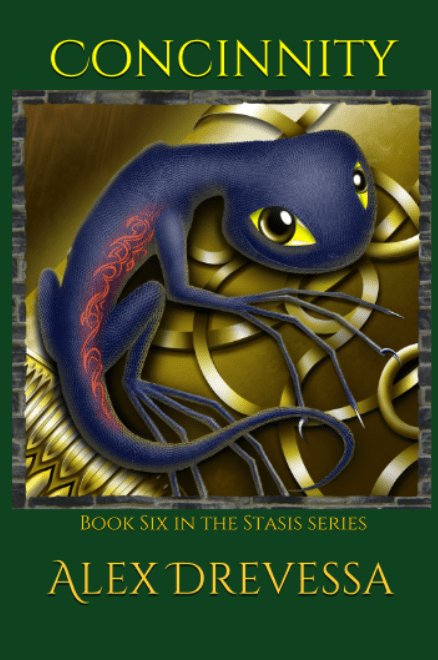
New Book Release: Concinnity

Link to purchase “Concinnity”

The three books, “Incubation,” “Emergence,” and “Concinnity,” comprise seven-year old Marcel’s first time-traveling trip– a quest that sent him to medieval Ireland.

I’d planned to write one book for Marcel, one for Pierre (involving pirates and De Soto’s misadventures, and giving hints at Thomas’s origins), and one for Charly (in France). But during his adventure, Marcel changed in ways I hadn’t anticipated, and the people he met along the way had their own stories, and so much more was going on than I’d realized at first, that it simply took much longer to reach the end of his quest than my research, maps, and plans had initially led me to believe.

I’ve loved sharing this place and time with these new friends– and with my ever-patient family. I hope this book will entertain and delight you, and perhaps something more.

–Alex Drevessa

Cover art by Arcanadragon

Hermitcraft Invasion

Once again, the same six notes stuck in my head. A short tune sung by a young man with a pleasant voice, a tone of shyness, and a Swedish accent mellowed by years of conversation with friends across the North Sea.

It began a few months ago. I was about to get on the BowFlex (and start one of my “Great Courses” lectures) while my kids ate breakfast. My oldest son checked his computer, then announced, “Gree-Anne uploaded a new episode!”

I rolled my eyes. “Is this one of those ‘watch other people play Minecraft’ things?”

My youngest daughter told the others that they shouldn’t let me watch, that I wouldn’t “get it,” and my lack of appreciation would spoil it for the rest of them. But she was outnumbered by her siblings. I said, “Fine. I promise not to say anything disparaging.”

As I started getting my heart-rate up, I learned that it was the Grand Opening of a “redstone build” that they’d named “Sahara” (pronounced the way Sting sings it in the Police song “Tea in the Sahara”) and that, like its antecedent IRL corporation, it was designed to deliver products quickly at competitive prices.

My first out-loud laugh came when I learned they’d just accidentally blown up their only customer when they launched their celebratory fireworks. A short time later I was panting/shouting at the screen, “That’s why you have a soft-opening! What are you thinking, guys?” And when a certain person got long-winded and Grian (the “Gree-Anne” I’d heard earlier) gently nudged him a little, and then a little more, and then a little more, until he fell off the platform, I was laughing so hard I had to stop my workout for a second to catch my breath. (My kids, knowing how much I loathe meetings, and how absolutely efficiently I try to run them when I have to be in charge of one, were laughing at how much I was laughing, and accused me of wishing I could do that to certain people.)

A few days later, at a big church dance, a fellow mom was talking to me about her kids, and complaining that it isn’t bad enough that they play videogames, themselves, but now they like to watch other people playing videogames. I turned to her son and said, “Do you watch Hermitcraft?”

He nodded.

“Did you see the Grand Opening of Sahara?”

He smiled.

I turned to his mom. “It was hilarious. There was this big machine they’d made, and instead of…”

Pretty soon the room was alive with other kids joining in, informing me that there was this whole subplot I’d missed of Grian gumming up the works by throwing in a potato, and didn’t I see the second Grand Opening where the customer who’d gotten blown up was now standing WAY off in the distance to watch the celebratory fireworks, and, and, and…

So now I’m hooked, to the point that the other morning my kids said, “There’s a live-stream today with Mumbo-Jumbo…”

“I’m not letting you watch someone click on blocks of sand for two hours.”

“No, Mom. He and Iskall are going End Busting.”

“Which means?”

“They’re going to find villages in the End and fight things and get stuff you can’t get anywhere else.”

“Mumbo is going with Iskall?” (Iskall85 is the only Hermit I’ve subscribed to, myself.) [Personally, I think his current Omega Tree build is (subconsciously) influenced by the World Tree (Yggdrasil) myth of ancient Scandinavian culture; this, even though Nassim Taleb might argue it’s foolish to start with a creative work and look backwards to find cultural inspiration for it.]

“Yeah, Mom. It’s starting right now!”

Well, they were all more than up-to-date with their schoolwork, and we never actually took a Spring Break, and I had a couple dozen mindless tasks that I’d pushed off too long and really needed to get done, so I said okay, but just for an hour or ninety minutes.

“Don’t worry. It’s only going to be an hour.”

Close to four hours later, pretty much all of us, including the young men who were live-streaming, were fairly slap-happy with silliness.

And now, this past week, at completely random moments (doing dishes, hiking, working on a legal project), the tiny bit of tune plays through my head:

“Do you even bust, bro?”

Hiking Horsetail Falls, Alpine, Utah

I took this hike at the end of July. It’s a gorgeous trail with plenty of shade, cold mountain streams, huge boulders, flowers, pine and aspen trees, a meadow, and views of the enchanting falls themselves.

Be sure to bring plenty of water on this hike, especially if you go in summer. Things to beware of on this trail include: loose rocks, steep inclines, creek crossings, rough patches, and an occasional nasty pile of horse poop.

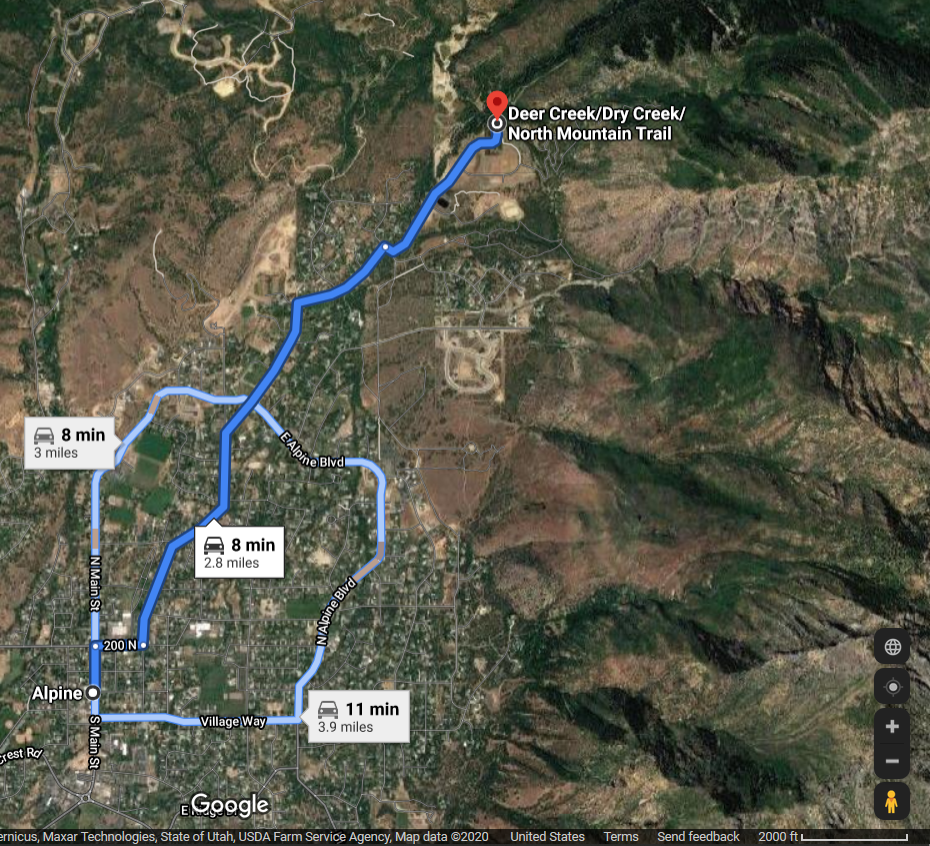
The trail head is just a short drive from the center of Alpine, Utah.

Map from Alpine to Trail Head

The trail is two miles long, but then you have to hike back down, making it a total of four miles. Its elevation changes by 1,617 feet, so plan on taking it slow. Personally, I spent about 90 minutes going up and about an hour going down, although I was stopping along the way to briefly talk with friendly people and to take pictures and videos.

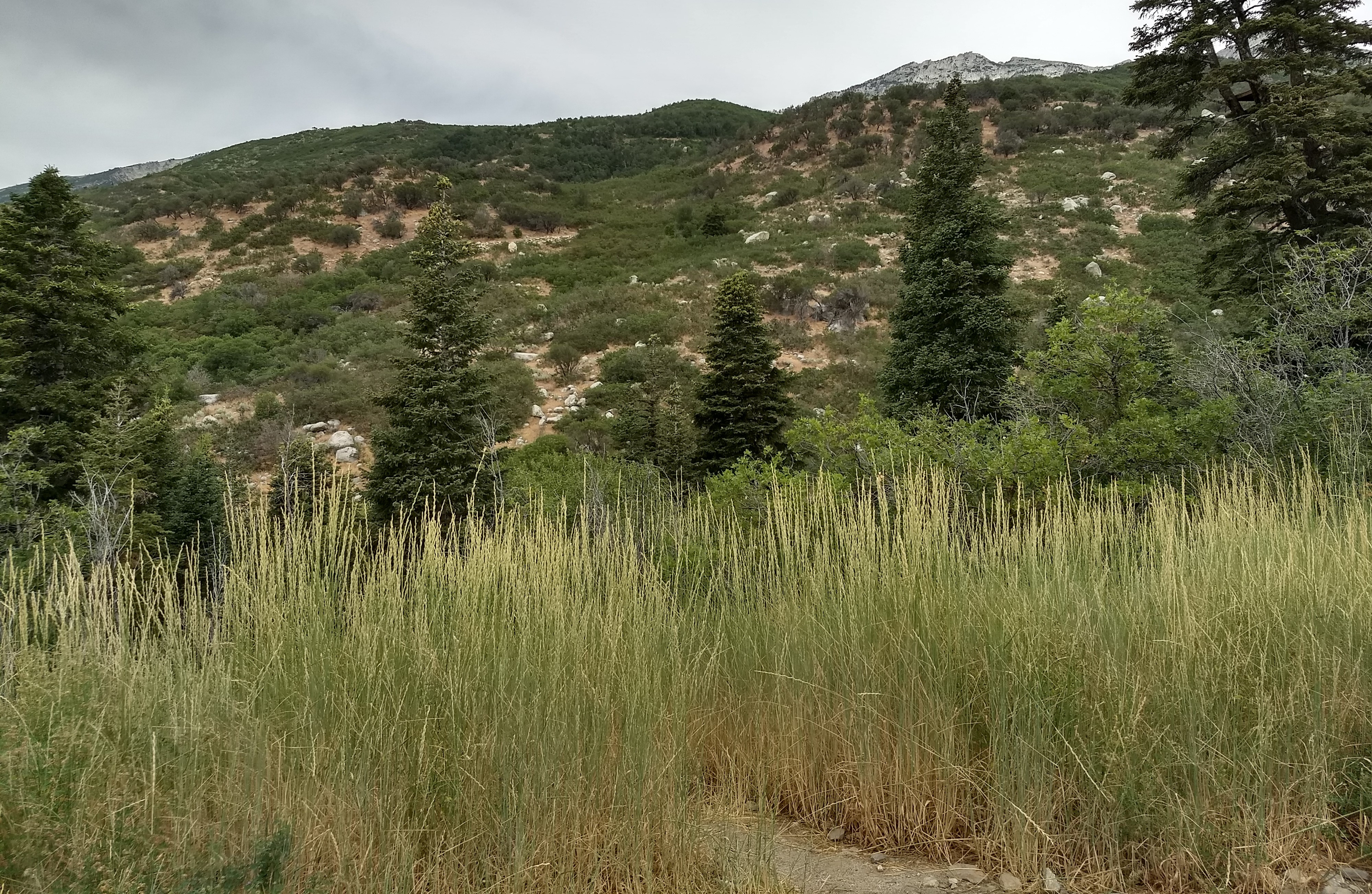
You’ll park in the gravel lot, then begin the hike north on a rocky path through tall grass. Soon you’ll be able to see the near mountain peaks: View from the trail head.

View from lower end of trail

Once you get into the forest, the views disappear, replaced with other beauties all along the way. Meeting a butterfly

About forty minutes up, there’s a short side trail marked by intriguing round boulders about as tall as your waist. This trail gives you a distant glimpse of the falls: Boulder trail to far view of falls.

Although the towering trees become thicker as you continue higher, there’s still enough light reaching the forest floor to let drifts of asters bloom under the tall pines: Asters and tall pines. Often along the trail you’ll see huge boulders and giant trees laid flat along the slopes– picturesque reminders of how wild and dangerous the mountains can be.

About two-thirds of the way up, the trail opens into a pretty meadow, the most level and easy part of the trail. It’s a short rest that contrasts with what comes next. Walking into the meadow

Much of the higher part of the trail is crossed by, or even composed of, wide, shallow creek beds. The clear water flows from melting glaciers higher up, and feels extremely refreshing until your toes go numb. Crossing the shallow stream  Other trickling streams are so small and hidden among the plants that you hear them before you see them. Rivulet

At last, up ahead, through the trees, you’ll spy a signpost:

When you reach the signpost, take the trail on the left. Continue on, but not very far. On the left side of the trail, down the slope, look for a small tree with a black rope tied to it. Finding the rope to go down the trail to the falls Grab firm hold of that rope, and use it to help yourself go down the extremely steep beginning part of the trail to the falls.

This trail is skinny, damp, and rugged. It’s full of sweet-smelling plants that I couldn’t identify, but maybe you can from these videos: Lovely smells * More lovely smells. The trail is lush to the point of being overgrown– plants will constantly be brushing against your skin and hair.

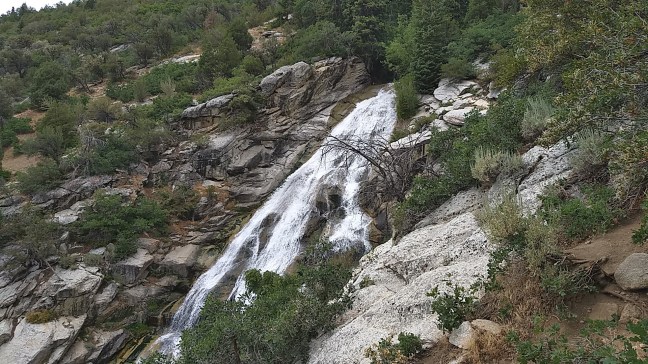
Soon you’ll start to hear the roaring of the falls. Then you’ll come out on the rocky ledge, and at last you’ll have this beautiful view: At the falls. I stayed a few minutes to enjoy the scene. I had to be careful, because the steep rock surface was slippery with dust and grit, and I didn’t want to end up on the news as: “Stupid Hiker Dies at Falls.” I was tempted to try to get within touching distance of the water, but this same worry forestalled me.

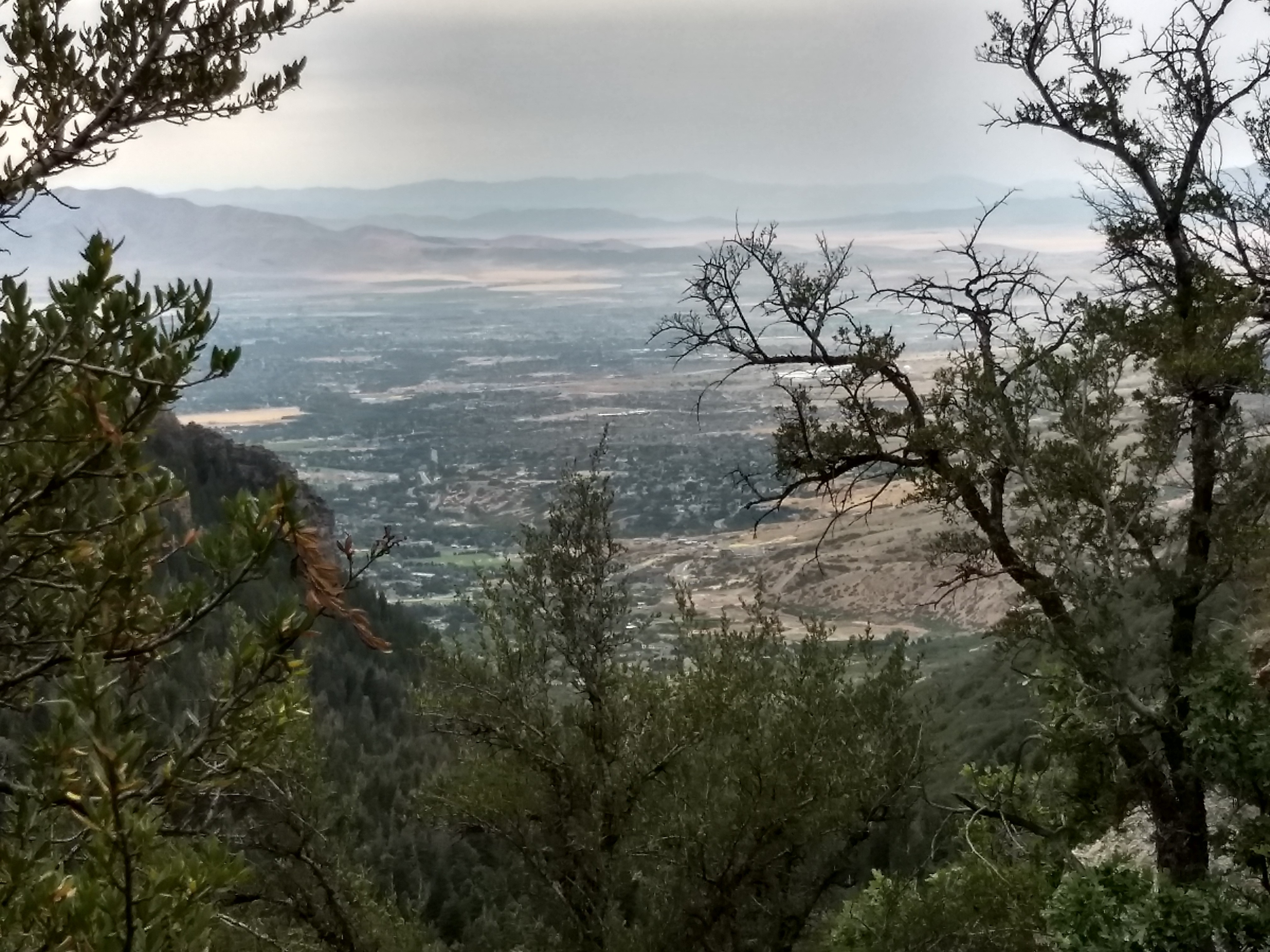
On the way back I caught a view I’d missed on the way up:

View from a lookout spot

This trail had my favorite amount of traffic on it: short periods of time when I couldn’t see or hear anyone else, periodic quick greetings with fellow-hikers, and even an occasional short chat with the friendliest hikers or those who needed a little guidance.

As I was writing this post, I came across a great website that describes this and many other trails: AllTrails.com. I used the information on that site to find out how long the Horsetail Falls trail really was, and what the change in elevation was on the trail. Now that I know that website exists, I’ll have to use it to find some other great places to explore.

Happy wandering!

Popular Astrophysicist Unwittingly Defines “Hell”

Warning: This is a religious post. Also, these are only my personal thoughts, and are in NO WAY an attempt to make an official statement of any religion.

At the end of chapter six, “Dark Matter,” in Dr. Neil deGrasse Tyson’s book “Astrophysics for People in a Hurry,” he says, “Behold my recurring nightmare: Are we, too, missing some basic pieces of the universe that once were? What part of the cosmic history book has been marked ‘access denied’? What remains absent from our theories and equations that ought to be there, leaving us groping for answers we may never find?”

To me, this quote describes the hell it would eventually be, to be sentenced to any post-mortal existence where knowledge is limited.

As I consider that Telestial beings (murderers, rapists, thieves, liars) are limited to the knowledge and power of a Telestial world, that this earth is in a Telestial state, and that all the pretty-well-understood forces operating on this earth tend towards disorganization, I surmise that post-mortal life in the Telestial kingdom is always a struggle against slipping backwards. You are Sisyphus and his rock, unable to get beyond the immediate problem of decline.

I suspect the Terrestrial kingdom (decent folk who’ve reached a plateau and refused to become more) is a place where things are fairly stagnant. They neither decay nor expand. People are separate and single– individuals have neither root nor branch (ancestors nor progeny) because they never made ties that could withstand trial by fire. How soon before the charm of sameness fades? This is a kingdom of glory, and things are somewhat pleasant, like a post-mortal Garden of Eden. But what you can learn and become has a limit– and, therefore, it’s still the nightmare Dr. Tyson describes.

I think Celestial beings (those who use time well, are kind, judge righteous judgement, make every organization they’re part of stronger and happier, make mistakes but always try again and trust God to make up the difference, improve their talents, those who could slap their worn-down, scarred bodies on the judgement bar as visible proof of their service to others) are ready to live where they can continue what they’ve been doing during this mortal section of their eternal lives. They never reach a place where “the cosmic history book has been marked ‘access denied’[,]” or they are left “groping for answers [they] may never find[.]” Quite the opposite– the universe’s knowledge flows to that person, “without compulsory means.”

I get the feeling that Dr. Tyson doesn’t have much use for religion. But I love the way he lets knowledge flow through him to people like me (a celestial quality in him, eh?). Perhaps he’d roll his eyes at my use of his sentiments, but he succinctly described a final result where we immortals are prohibited from learning more. My life is better for believing that’s an avoidable fate.

Some might say it’s blasphemous to believe that we, God’s children, could, in some far-off eternity, actually keep His commandment to become like Him. But I say, anything else is hell. I think the physics backs me up…

NaNoWriMo Success (ish)!

I started National Novel Writing Month (NaNoWriMo) with about 54,000 words written in Book Six of the “Stasis” series. At this moment the book is 85,300 words. That means I fell 18,700 words short of the NaNoWriMo goal of writing 50,000 words in one month.

In decimal form, I accomplished 62.6% of my goal. If this had been a class, I’d have a D minus. The worst passing grade you can get.

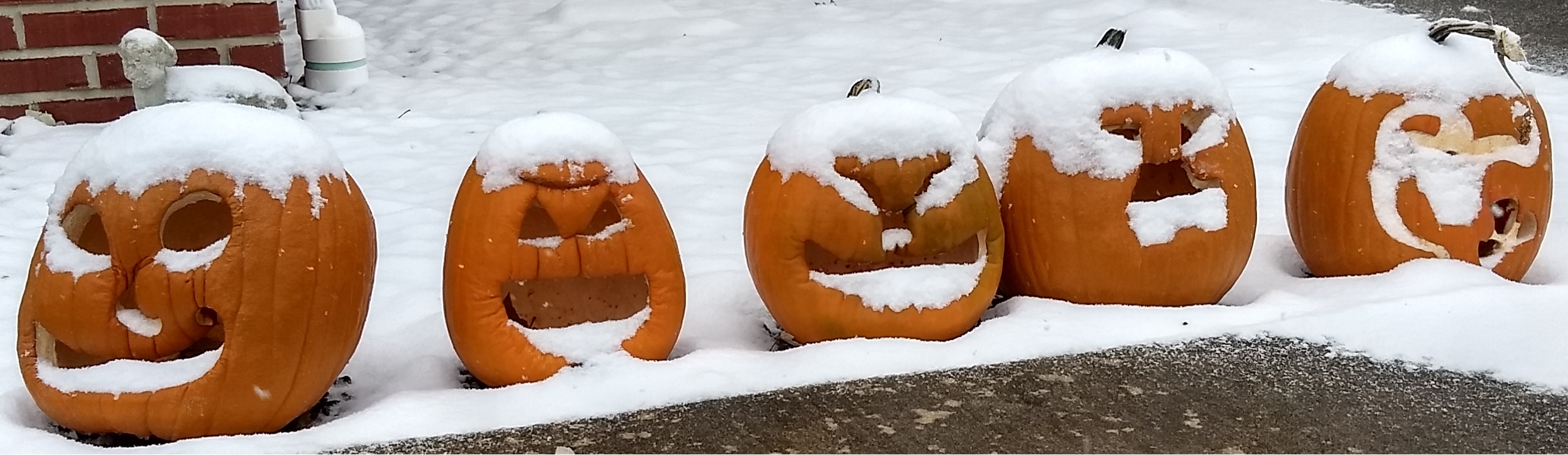
In picture form, my hopes of reaching 50,000 words had a progression something like this:

JackOLanternsFirstDay
Bright optimism

JackOLanternsNextDay
Winter of discontent

JackOLanternsLastDay
Mushy despair

It’s much like when I took Calculus 112. I listened in class, I did all the homework, and I studied for the tests in order to achieve my goal of getting an A. But my grades kept coming in worse than I’d hoped. As finals approached, I determined that I needed a 69% on the exam in order to have a “B” for my semester grade. I crammed, I went to the testing center, I worked through every minute they allowed me, and at last I turned in my final. Then I gathered with the crowd of students waiting for their name and test score to appear on the screen. The dread in that little vestibule was palpable.

Finally, my name flashed on the screen, accompanied by a huge “69% D.” I yelled, “YES!” and happily left the room, to the perplexed stares of the other students.

Circling back to NaNoWriMo, I’m happy with my D minus there, too. I really like those 31,300 words I wrote this month. The book has taken some turns that completely surprised me. I’ve loved getting to know some of these secondary characters that have troubles and passions all their own. I wish the end of the book were already in existence because I can’t wait to see what happens next. And, I cut out several thousand words I didn’t like.

Yes, I didn’t meet my goal of having 104,000 words by the end of this month. My hopes, like the Jack-o’-lanterns, turned to mush. But unlike the Jack-o’-lanterns and Calc 112, instead of ending up with something nasty or barely passable, I think I ended up with something like this:

PumpkinPie
Pumpkin Pie Happiness

Congratulations to everyone who had a NaNoWriMo success (or success-ish) this year!