My whole life, I’ve enjoyed performing in theater and music; in more recent years, I’ve taken assistant director roles for middle school and high school plays and musicals. In the early 2010s, my church (currently about 17 million members) began a project to make short videos depicting events in the scriptures. (One of the main goals for this project was to make the scriptures more accessible to people the world over.) Every year for more than a decade, I filled out the application to be an extra in the coming year’s shooting season. Some years, when they had minor parts with lines available, I memorized, recorded, and uploaded my audition. But I never got a callback.
Then, in 2019, I got a booking! I left Missouri and flew out to the Utah desert. For one day I was an affluent Zoramite worshiping idols. It was a long, hot day (pre-dawn to dusk, about 106 degrees) and I loved every moment (my post in “To Beard or Not to Beard” talks a little about that day).
I applied again the next year, but the season was cancelled due to COVID. I re-applied the year after that, and months later I got an email. I opened it, hoping it was a booking, and wishing I might get two or maybe even three days.
I was offered 23 shoot days over five-and-a-half weeks.
I read it again. Then I wondered if it was meant for someone else and I got it by mistake. (I don’t know that I’ve ever completely gotten over that feeling.) I’d never left my kids alone for more than four days, and that was only while giving birth to one of them. But they assured me that they’d be okay (they were all in their mid-to-late teens, they’d been to overnight camps and conferences, etc.; it’s just that this was for a much longer time and distance away).
Soon after this, my oldest son was offered three shoot days, then six more, so I had his company for part of the time.
My brother, who lives about an hour from the set in Utah, let me stay with his family and borrow his car for free. So, he and his family are heroes who made this possible for me.
FIRST DAY
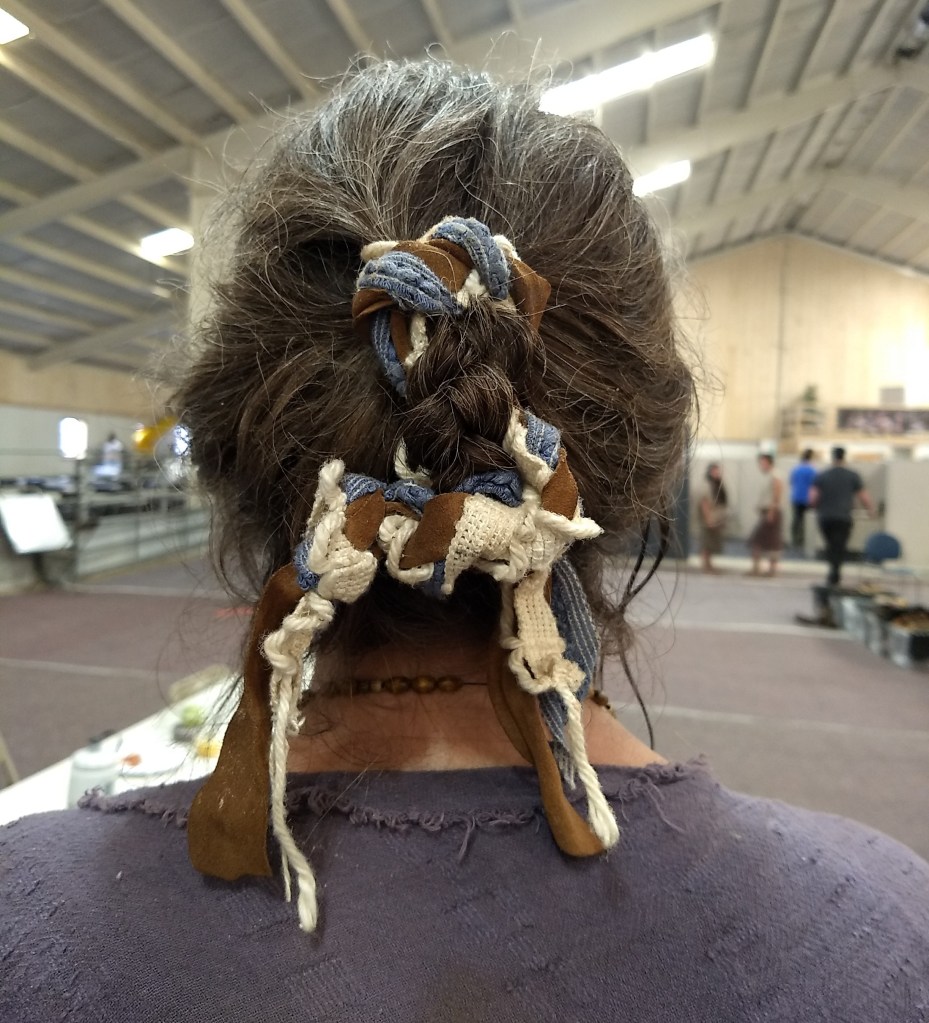
I drove in the dark to the remote desert canyon. Attendants told me where to park. I walked to the shivering cold barn (desert nights are cold; desert days are hot) and checked in to begin the process of getting ready for the shoot: lots of stations, lots of lines for each station. As part of the forty “core” extras, I was assigned a specific costume (freshly laundered) that I would wear every day for the next five-plus weeks. From the buckets of sandals, I choose a pair that I hoped would not give me blisters. I ducked into one of the several curtained partitions to change. Then I got inspected to make sure I had no makeup, nail polish, or jewelry. Then to “skin tone” to cover my tan lines and get sunscreen. Then outside to “dirt,” where I got two layers of spray dirt on my skin and some special dirt brushed all over my costume. Then back inside to get my accessories. Then to hair, where I was given the coif which would be replicated exactly the same way for each day of filming (they chose a quasi up-do which was parted down the middle to show off my gray to maximum effect). They used my phone to take pictures so I could show the “hair” people the next morning and every morning thereafter. (Phones were banished on-set, and reception was terrible in that remote area, but they still served their purpose.)
The sun came up, and vans took us up a rocky dirt road. A strong guy (who turned out to be a university art professor that had taught my daughter in a week-long design program) mentioned it’d be cool to carry one of the young goats on his shoulder. Somehow, it came to pass. (I may have mentioned something about it to one of the assistants.) He carried the constantly bleating animal for the next hour while we walked back and forth through the mountain field.
Then the vans took us higher. When the terrain became too steep for the vehicles, we unloaded and walked way up the trail. Others who had been driven up earlier had already claimed the sparse shade from the scrub oaks, so I continued up the trail, rounding a bend, until I found a tiny bit of shade further up the mountainside. Then we waited for them to finish setting up the shot. I crouched into the bushy trees and put my bag and gourd over my feet to shield my toes from the burning sun.
After some minutes of waiting up there, alone, I heard a large rustle from the center of a stand of scrub oaks not too far away. I stared at it, and I determined there was no wind and the rustle was too big to be one of the prairie dogs that had just run from that area. I knew of recent cougar sightings (and even attacks) in remote mountain areas in that area in Utah, so I was concerned. A few minutes later, another large rustle came from the same patch of scrubby trees, but closer. I decided I didn’t want to be the idiot woman who got eaten by a cougar on her first day of shooting, so I determined to go back down into the baking noon sunshine (Crew members later told me that the temperature on our ridge was 109 degrees). But just then, Abraham came into view. (Abraham was easily the largest and strongest man on set. In later weeks, other extras told me about going to the gym with him and seeing him load five 100-pound plates on a machine and lifting them.) He asked if I minded if he sat with me. I said he was welcome. He took a scrub oak a few feet higher than mine. As we talked about his amazing life experiences, I felt perfectly safe–no cougar would ever be so stupid as to attack with him nearby. And, there was no more rustling. (A few days later I told him he saved my life that day.)
They set up the ridge shot, and we walked along it several times with our sure-footed goats and sheep while we learned not to look at the drone zipping by just over our heads.
We walked back down to the vans and were driven to the barn for a late lunch. Then we went far away to a completely different field up in the mountains. While they set up the shot, they brought camp chairs for us and we set them up in the shade. They continued to ply us with water and electrolytes. Then they brought out a basket of chocolate balls, and everything became right with the world. When the shot was ready, they ordered us in groups and set us up at the top of the long meadow. Then they said, “You need to PRETEND you’re hot and tired,” which drew a laugh out of us. They told us to imagine what our own character had just been through, to create a story for this individual we were trying to inhabit. I created that story, and then hiked wearily up and down the meadow for the last takes of the day.
Back at the barn, with the sun about to set, I changed out of my filthy outfit and accessories and hung them up. As I was checking out, I suggested that, if we were supposed to be this dirty tomorrow, maybe we should just sleep in the dirt on the barn floor. Instead of laughing at my joke, they quickly reminded all of us of the importance of personal hygiene.
When I got home, it was dark, which was a blessing because my eyes had been stinging from being out in the sun all day. When I met my nieces and nephew, they looked aghast at my filthiness. I agreed with them that I “really, really, really” needed to get cleaned up. Then I went downstairs to the bathroom and felt thankful for the blessing of lots of soap and clean, hot, running water.
THE LIGHT
In filming the scenes with Christ, the actor’s flowing robes were kept brilliantly white–before each shot, they were inspected to make sure no speck of dirt had dared adhere to them. During the first shot, the sun was almost directly behind him. A gigantic light-box suspended from a crane illuminated him. And, lest there be a shadow of a chance of a shadow, another light source took care of that. I could barely look at him, he was glowing so brightly.
We ran the scene many times, from many angles. It was physically exhausting in the heat and sun, of course. But it was also emotionally exhausting, in a wonderful way.
At one point in the late afternoon, a large bank of clouds rolled in, graciously sheltering us from the sun’s onslaught. After a few minutes the director said, “I know some of you have been praying for better weather for the cast. But we need better weather for the shot. So, please pray for the sun to come out again.” I joined with the others who followed his admonition, and in a few minutes there was a small break in the clouds, which allowed them to get in the last three shots they needed before we broke for the evening.
TECHNICALITIES
Before every shot, the head cameraman would look through his camera and announce his light levels. The directors would make adjustments for him (moving screens, turning light boxes up or down, etc.). He’d check the shot and call out if he saw something out of place or if people needed to be rearranged, then the directors would make the needed changes happen, and then we’d finish the set-up and get straight to filming. He was extremely efficient and professional.
One of the days that had hundreds of extras, after we’d all been processed, we were placed seated on the ground in front of the temple. The assistants had discreetly placed pieces of carpet on the stairs to keep the actors’ feet from being singed on the steps that had already absorbed too much of the sun’s heat. We waited while mini railroad tracks were set for the cameras to run along during the shoot, and for the last screens and light boxes to be placed. Then we were arranged so the principle actors in the scene could easily walk through us without a huge amount of people shifting to make way but also without leaving obvious paths in the crowd. During this wait, I told a certain kid seated next to me to stop throwing mulch and dirt at the other little kids (and I reflected once again on the unfairness of the practicality that you always learn the names of the naughty kids first and the helpful kids second).
While filming a different city scene, one with lots of walking and lots of sheep and goats, between takes I heard a young lady shout: “You think that’s bad? I had a goat pellet stuck in my sandal! And they’re LACE-UP!!!”
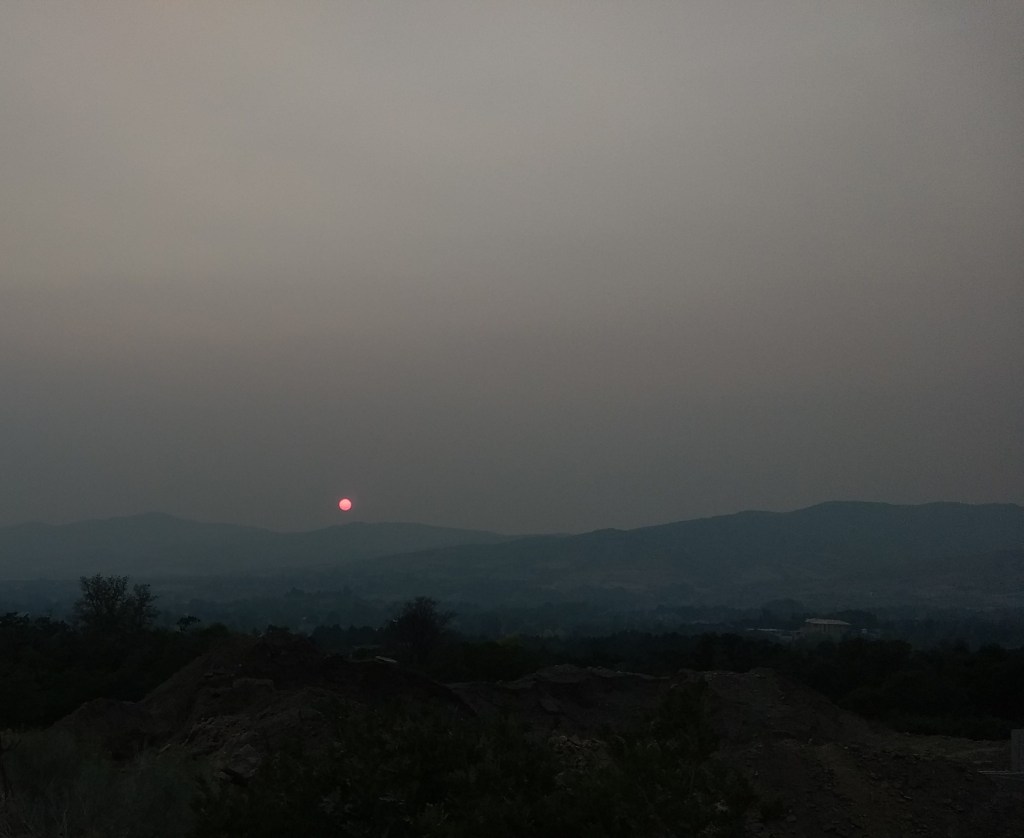
That summer, the California wildfires were so bad that on certain days you couldn’t even see the mountain peaks right next to us. On one of these very smoky, very long days (pre-dawn to almost dusk), the fire-lady still kept coming through to light the powdered walnut shells in the firepots to produce the smoke needed to filter the light and provide the right atmosphere to the film. Several people around me were complaining about the smell and about their eyes stinging. Some had even surreptitiously closed the cover of whichever firepot was nearest them. When the cameraman ordered, “More smoke!” there was an audible groan as the fire-lady immediately appeared with her blow-torch. There was some hostile murmuring as she approached my area. I decided something needed to be done to break the tension, so I yelled out, “We know you’re just doing your job, but: Fie upon you, Fire-Lady! Fie!” which made everyone laugh, including her.
During the filming of the passing of the sacrament, the director told us all to be thoughtful and reverent, and to take a piece of bread and eat it every time it was offered. One of the disciples came to our section of the multitude, offering his dish of bread to each of us in turn. When he offered it to me, as I reached for it, he withdrew it, so I retracted my hand, keeping a reverent, pondering expression on my face. He did this twice more, and I remained reverent as he teased me. Then he offered it in earnest, and I took a piece and ate it thoughtfully. When the scene was finished, he sought me out in the crowd, held up his hand for a high-five, and when I gave it to him, he said loudly, “You are a true actor. You didn’t break at all!” which made me glow inside.
While filming certain of Christ’s miracles, there was a white cloth above us, softening the brilliant sun. The director came to our group and said there should be a sacred feeling during this scene, a sacredness comparable to the temple. The camera was behind me, and I volunteered to have my shoulder frame the scene. The cameraman taught me exactly how to shift my weight so that I would always be in the right place as the actors entered the frame and the camera adjusted. I knew my face wouldn’t be in the shot. But I wanted to portray my character as best as I could to help my fellow actors who would be seen. As the actor portraying Christ whispered the words of each blessing, I imagined I was seeing Christ healing my own daughter, and my tears flowed freely. Later, different cast members took me aside and said watching my reactions helped them portray their parts. I was grateful to have been placed in such a way that I could help make the scene maybe even a little more real than it might otherwise have been.
One morning, it had rained the night before, so the lines were soaked, making it impossible to safely film the scene of the angels descending. While crew worked on replacing the wet lines on the crane with dry lines, the director decided to go ahead with filming the ground scenes of Christ and the angels among the children. When the lines were ready, they cut filming that scene and immediately started working on filming the angels’ descent. (“Raise the Angels!” should be the name of a rock album, I think…)
The angels were cast with the idea that they could be the ancestors of those children they were ministering to, so they had a similar look to everyone on the set. Those angels also had been chosen after submitting dance recitals. That showed in their absolute grace as the lines quickly took them from above the height of the top of the temple down to the center of the group of children. The morning clouds had separated, leaving swaths of blue sky and puffy white clouds as a dramatic sky-scape backdrop. The sun was in perfect position, the giant light box made their white robes glow, and a giant low-speed fans mounted just out of the shot made their robes flow gently and beautifully.
In the afternoon we went back to filming the angels and Christ on the ground with the children. Because the sun was on the opposite side of the set, the director rotated our group about 110 degrees from our morning positions so we would have the same light and shadow on us. The director told us that what we said didn’t matter because this would be filmed at a high frame rate and played back in slow-motion with music over it. The director said what was important was that all those tired little children were smiling and talking in wonder and joy. Anthony, who portrays Jesus, started talking to the children about pizza. Then he asked about sillier and sillier kinds of pizza: “What about chocolate pizza?” He asked who liked pineapple on their pizza, and when some kids eagerly responded, he looked at them and said, “You need to repent,” which made them all laugh.
Towards the end of filming that shot, all the ground angels joined the descending angels, and a whole bunch of really little children joined the circle. The littlest kids were quickly scooped up by the fastest-acting angels, but all of the kids were in demand. By the end of shooting the scene, one of the littlest children had fallen asleep on her angel’s shoulder. She was so sweet cuddled there.
FAMILY
Towards the end of the season of filming, one Friday the director surprised us by saying the next afternoon there would be a “Family Day,” and he authorized each of us to bring people in our household to the set during a certain window of time. During my time, I gave my brother, his wife, their kids, and my parents a tour of the set, pointing out where all these things I’d been telling them about had happened.
I was told that there were about 6,000 extras hired during that season. There were roughly 300 on higher-volume days, with those hundreds of faces changing from day to day. What was really cool on “Family Day” was that when some of the assistants and directors saw me, people that I had never supposed knew who I was, they called me by name and complimented me in front of my family. I was impressed at how they “knew all their sheep,” so to speak. I can only guess that it was partially because, over the weeks of filming, I had become known among the extras as the extra to tell if there was a problem so that I could loudly tell the director about it. (My two years of college Spanish somehow was enough to allow me to be helpful to those extras who only spoke Spanish–especially to those who were new on set) (Some examples of things I brought to the directors’ attention: we’d been given conflicting instructions on whether to kneel or to stand; we were continuing a shot from a previous day and a brand-new extra had gotten in a spot that was going to create a continuity problem and the guy wouldn’t go to the right place; one of the children’s noses had suddenly started bleeding and they were about to start filming; an elderly lady had briefly fainted and needed a chair to sit on and some medical attention; some new assistants were mistakenly passing out the red electrolyte packets that would stain everyone’s lips and fingers bright red and needed to be stopped that second; etc.)
Even though I kept the “Family Day” tour short and tried to keep my parents and nieces and nephew in the shade as much as possible, they were starting to get overpowered by the heat after only a half-hour. I had to go get the car and drive them back because I wasn’t sure my parents would make it the half-mile walk from the set to the parking area. I guess I was more acclimated than I’d realized.
As I neared the end of the filming, and I joyfully anticipated being reunited with my family, I was extremely grateful to have been a part of this experience. I told people it was like Boot Camp and Youth Conference (a religious retreat for young people) combined. There were constant problems to solve, and it was exhausting, but it was just about the coolest thing ever to work with a huge group of people you’ve never met who are all united in a common goal to help bring people to Christ.
POSTSCRIPT
Months later, the first finished, edited video was released during a session of General Conference (a twice-yearly event where the millions of church members, and everyone else in the world, are invited to listen to speakers teach about Jesus Christ). Several of my family members, and some of my friends, texted me to tell me they’d seen me in the video. I told them they had amazing eyes, to catch those couple of seconds here and there where I was recognizable.
Shortly after the videos were released, when I was visiting local congregations to teach, there were a few people who took me aside and asked if I was in those videos, because they thought they’d seen me. It was cool to me that I got to be a way of connecting them to those videos.
Another time, my family group text lit up when my sister spotted me in a picture (a still shot taken from the videos) in the church’s scripture study manual for the coming week’s lesson.
Finally, I was playing piano in my local congregation for the little kids’ Sunday School as the music leader (who’d recently moved here from another state) taught the children a new song, “Easter Hosanna.” To help the class understand the song, she’d downloaded the church video that showed the scene described in the song. She had it up on the big t.v., cued in such a way that my face took up half the screen. When Junior Primary came in, she played the video, explained the song, and taught the song to them as I accompanied on the piano. I was wondering if I should say anything about being in the video, but then I thought it would likely distract from, not enhance, the chorister’s work. Then the younger children left for their individual classes, and Senior Primary came in. As soon as the older children saw the t.v., they started calling my name and exclaiming, “Is that you?” A bunch of the Primary teachers joined in while the chorister said, “I was WONDERING if that was you!” So, I got to say yes, that was me. Then I briefly told them that there was a really special feeling on the set those days, and I hoped they could feel that as they watched the video (I’d had time to think of that smooth segue during Junior Primary).
 Alex Drevessa
You must be logged in to post a comment.